 For Thursday, our last full day together, we were contemplating taking a trip to Hampton Court Palace or Windsor. In the end we chose neither, opting for a trip down the river Thames to Greenwich, and it was a great decision. Even after just one visit, I adore Greenwich, and if I could move into the observatory, I would. But more on that in a second.
To get to Greenwich, you can either ride the Tube and switch to the Docklands Light Railway (DLR) at Canary Wharf, or you can get on one of the boats that cruise the Thames. We chose the faster, slightly cheaper commuter boat pictured here, the Thames Clippers, over the slower, slightly more expensive & more touristy boat. The commuter boat took about 40 minutes to travel from the Waterloo Millennium Pier (which is located right beneath the London Eye) to Greenwich. The trip on the river was a lot of fun and very scenic! It is a great way to view the city.


The London Eye; St Paul's & Millenium Bridge (doesn't it resemble a spine?)


Tower of London; Tower Bridge from the East
 After we disembarked from the pier at Greenwich, we walked by the Cutty Sark, which unfortunately was closed for renovations. Feeling a bit peckish, we stopped at a local pub, the Spanish Galleon, for a bite to eat. I had a cheddar & pickle sandwich, which was quite tasty.
Then we walked toward the green spaces, of which there are many in Greenwich! I couldn't stop taking pictures of all the daffodils that were blooming. It was so lovely! I've limited myself to only posting a few of them here, and it was a very difficult editing process, I assure you. :)


Such a handsome bunch!
Okay, okay, enough flowers. :)
 One of the nice things about Greenwich is that most of the sights are free! And of course, the beautiful vistas don't cost anything either, like the view towards Canary Wharf, at left, and the marvelous juxtaposition of old & new it provides.
 Our first stop was the National Maritime Museum, which contains Lord Nelson's coat and more ship models & naval memorabilia than you can shake a stick at. From there we walked over to the Queen's House, which is a beautiful building (unfortunately no photos allowed inside) that has been turned into an art gallery. Upon exiting the Queen's House, our eyes beheld the Royal Observatory, perched upon a hill just behind us, and hiked to the top.


Royal Observatory; The road to the Observatory
Upon reaching the top of the hill, you are rewarded with the most amazing views of London that I've seen. On the far left, you can see the City of London, including St. Paul's and the Gherkin, straight ahead is Canary Wharf, and to the right are landmarks such as the distinctive O2 Arena.


City of London; Greenwich & Canary Wharf


The park on top of the hill; Mom & Dad
The Royal Observatory was really interesting. It was commissioned by King Charles II in 1675 with the purpose of charting the night skies in order to provide the data to ships so that they could calculate longitude at sea by examining the stars. The story of how they solved the longitude "problem" is fascinating, and I spent a lot of time looking at all the exhibits in the museum.
 Time & longitude are directly related, and knowing the time at a certain reference point is needed in order to calculate it. One way to figure out the time at the reference point was to bring a clock with you that was set to that time. But this was not easy. We think nothing of buying a $10 watch that we can take with us on planes, trains & automobiles now, but finding a mechanical time piece that would work accurately on a ship was a challenge. The British Government set up a Longitude Prize in 1714 to encourage people to tackle this problem, and even then it took 50 years before John Harrison solved it with his chronometer.
 The other problem was where to set up the reference point. After an international convention, it was decided (with notable detractors such as France, not surprisingly) to place it in Britian. Probably the most famous attraction in Greenwich, located in (or I should say running through) the Royal Observatory, is the Prime Meridian.


Prime Meridian
After taking in one last view of the city beneath us, we headed back down to town and rode the rails home instead of the river. When we arrived from the DLR to the Canary Wharf tube station, I was shocked at how huge it was.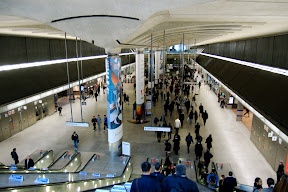 The place was a zoo, especially since we were there right at rush hour. But it was all very orderly. At many stations along the Jubilee line, there are doors at the platform, so you know exactly where the doors of the train will be. This allows people to queue for the train in a fairly civilized manner.
 The place was a zoo, especially since we were there right at rush hour. But it was all very orderly. At many stations along the Jubilee line, there are doors at the platform, so you know exactly where the doors of the train will be. This allows people to queue for the train in a fairly civilized manner.
I think I still prefer the river journey, though, and if we had bought return tickets, it would have been about the same price as the tube/DLR method. And even a few extra pounds would be worth it to not be squished in a hot, crowded car.
I'm so glad that my family was able to visit! I was very sad to see them go. We had a great time and now have lots of memories.
For more Greenwich pictures, go here.

 Our tour guide,


 On Saturday we took a day trip to Cambridge, which is famous for its university, scientific discovery, and Pink Floyd. We decided to do something a little different with this excursion and joined a guided walking tour to and from London. The company is called
  We began our journey at the Kings Cross train station, which is a bit of a tourist destination in itself, at least for Harry Potter fans. Having never read the books or seen the movies, I don't know what the significance of Platform 9 3/4 is, but there were a ton of people taking pictures of the sign (which is fake--there aren't any trains nearby, and it's actually been moved to a random corner of the station due to all the construction taking place there).
  When we arrived at the Cambridge train station, we were met by a coach bus that drove us out to the
  Our guide pointed out two names engraved on the "Wall of the Missing" that would be familiar to most Americans. The first was Joseph P. Kennedy of Massachusetts, older brother of John F. Kennedy. The second was the name of Alton G. Miller, who is more commonly known as

 One of the first things Simon told us was that Cambridge is a town of about 100,000 people, but it has 30,000 bicycles. This is because students at Cambridge University are not allowed to have cars. Even Prince Charles, who was a student at Cambridge several decades ago, rode a bike here. Simon also told us to try to stay out of the road or else risk being run down by a bicycle (I initially scoffed at this, but it is so totally true--I nearly got hit a couple times).
  Simon gave us lots of information on the history of the area going back to the Romans, the creation of Cambridge University, the founding of many of its colleges (mostly by rich people who wanted their names to live on), famous people who have studied at Cambridge (Charles Darwin, John Harvard, Sacha Baron Cohen), and the many scientific breakthroughs that were made here (discovery of the electron, discovery of DNA, the


